
Louisville is one of the most humid major cities in the United States. Summer dewpoints sit above 70 degrees for weeks at a time, and basements often run above 80 percent relative humidity year round. That puts almost every home in Jefferson County one slow plumbing leak, one cool surface, or one missed crawl space vapor barrier away from a mold problem.
This guide covers why the Ohio Valley climate is so mold-friendly, where mold actually grows in Louisville homes, when to test and when to skip testing, what real IICRC S520 remediation looks like, and how insurance treats mold differently from water damage.
Why Louisville is a mold-friendly climate
Mold needs three things: a food source (organic material like drywall, wood, or paper), oxygen, and moisture. Louisville's climate hands the moisture to mold spores year round. Summer dewpoints regularly sit above 70 degrees, which means basements, crawl spaces, and any cool indoor surface (AC supply registers, exterior walls behind furniture) attract condensation. Winter is drier outdoors but indoor humidity in tight modern homes stays high enough for mold to keep growing in cold corners.
Where Louisville mold actually grows
- Basements, especially along the floor-to-wall joint and behind finished walls
- Crawl spaces with damp dirt floors and no vapor barrier
- Behind bathtubs and showers with failed grout or caulk
- Behind washer hookups where slow drip pans never dry out
- Around HVAC supply registers where cold air hits a humid ceiling
- Inside wall cavities downstream of an old, undetected pipe leak
- Window sills and around AC condensate lines in summer
When to test and when to skip testing
If you can see mold and you know the source, testing usually does not change the remediation scope and often is not worth the cost. Test when you smell mold but cannot find it, when an occupant has unexplained respiratory symptoms, or when you need documented clearance after remediation. Use a third party industrial hygienist for testing, not the company doing the remediation, to avoid conflicts of interest.
How proper IICRC S520 remediation works
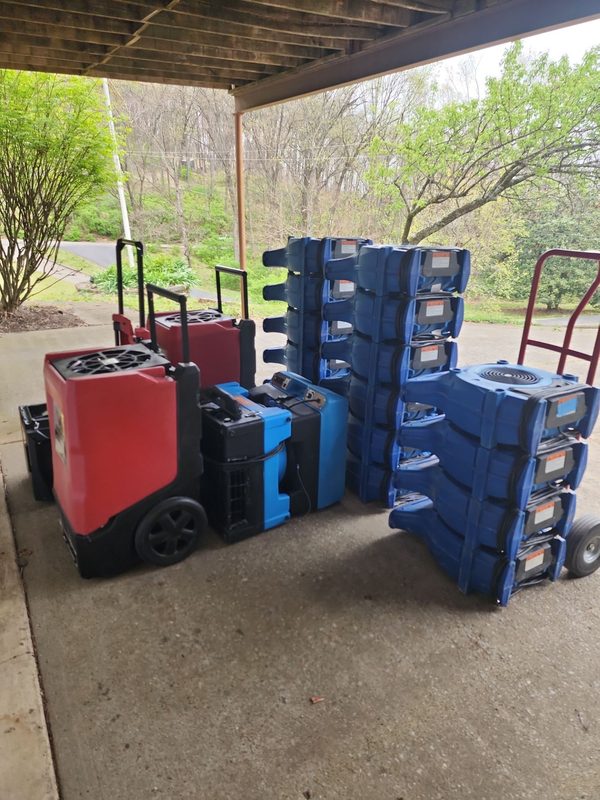
Real remediation is not spraying bleach on a wall. The IICRC S520 standard requires identifying and fixing the moisture source first, containing the work area with negative air pressure to prevent cross-contamination, removing all non-salvageable porous materials (drywall, carpet, insulation), HEPA-filtered air scrubbing throughout the work, antimicrobial treatment of all affected substrates, and post-remediation verification before rebuild.
- Fix the moisture source first or the mold returns within months
- Containment with plastic sheeting and negative air machines
- Personal protective equipment: respirators, suits, gloves
- Removal of porous materials past the visible growth line
- HEPA vacuuming and damp wiping of remaining structural surfaces
- Third party clearance testing before reconstruction
Insurance and mold
Most Kentucky homeowner policies have a mold sub-limit (often $5,000 to $10,000) that pays for remediation only when the mold resulted from a covered water loss like a sudden pipe burst. Mold that grew from chronic seepage, deferred maintenance, or long-term humidity is almost always excluded. This is why same-day response to any water loss matters so much: documented fast drying keeps mold off the table.
Why DIY mold work usually makes things worse
The single biggest risk in DIY mold removal is cross contamination. Disturbing visible mold launches spores into the air, where they drift on currents, settle in clean rooms, and germinate weeks later in places you never knew were affected. Real remediation creates negative air containment with HEPA filtration so spores are extracted, not redistributed. A box fan in a window does the opposite.
The most expensive mold jobs we are called to fix are jobs a previous contractor (or homeowner) cleaned without containment. Spores ended up throughout the rest of the home, and the second remediation costs five times the first.
How insurance actually treats mold in Kentucky
Most Kentucky homeowner policies treat mold as a follow-on to a covered water loss, capped at a sub-limit (often $5,000 to $10,000). Mold from gradual seepage, a leak that ran for months before discovery, or chronic high humidity is usually excluded entirely.
The fastest path to coverage is to address the underlying water source immediately and document it. A burst supply line, a sudden roof leak, or a water heater failure that you respond to within hours leaves a clear paper trail. A slow leak under a sink that you noticed six months ago does not.
Need professional help with this in Louisville or Jefferson County? Our IICRC-certified crews respond 24/7.
Call (502) 883-5043